
Of the two medieval towers standing side by side at the end of Via Rizzoli, one draws every camera. The Torre Garisenda is shorter than its neighbor, the Torre degli Asinelli, but it leans so visibly that it looks, from certain angles, as though it is about to fall into the street. It isn't about to fall. But it has been watched, propped, and more recently fenced off, with an intensity that tells you something about how seriously Bologna takes its medieval skyline. This is why it leans, and what is actually happening around its base right now.
A lean that is older than the problem looks
The Garisenda and the Asinelli are the survivors of what was once a small forest of private tower-houses, built by noble families in the decades around 1100 as a mix of status symbol, lookout post, and defensive stronghold. Bologna had dozens of these towers; most were pulled down, collapsed, or quietly dismantled over the centuries once they stopped being useful and started being a hazard. The two that remain, now collectively known as the Due Torri, happened to survive largely because they were central, tall, and eventually too expensive or too risky to remove entirely.
The Garisenda began tilting early, most likely because of subsidence in the ground beneath one side of its foundations rather than any flaw in the masonry itself. Bologna's subsoil is soft and uneven in places, and a tower built quickly and heavily, without modern foundation engineering, was always vulnerable to settling unevenly. By the fourteenth century the lean was already pronounced enough that the top section of the tower was removed, cutting its height down and, not incidentally, reducing the load pressing on the compromised side. The tower you see today is that shortened version: a tower that was, in effect, deliberately made smaller in order to make it safer.
It worked, after a fashion, for roughly seven centuries. The lean did not disappear, but it did not progress quickly enough to threaten imminent collapse either, and generations of Bolognesi lived alongside a visibly tilted tower with what amounted to confident indifference.
Why engineers started paying closer attention
That indifference ended in the early 2020s, when monitoring data showed the tower's movement accelerating beyond what had been considered its normal, extremely slow drift. Sensors attached to the structure, feeding continuous readings to engineers and to Italy's national research council, picked up shifts that were small in absolute terms but significant against centuries of near-stability. The response was immediate and visible: the area around the Garisenda's base was closed to the public, a protective structure went up around it, and a formal consolidation project began.
The work centers on stabilizing the foundations and tying the structure together internally so that the existing lean is held rather than reversed. Nobody is trying to straighten the Garisenda; the goal is to stop any further tilting and secure it in the position it has held for most of its life. This kind of work is necessarily slow, since it involves careful intervention on a structure that is both a functioning piece of historic fabric and, now, a monitored engineering subject. Note Expect the perimeter around the tower's base to remain in place for the duration of the works, and do not expect a fixed finishing date — ongoing structural consolidation projects of this kind rarely run to a published calendar, and Bologna's city authorities have not committed to one.

What you can actually see and do now
The practical consequence for a visitor is straightforward: you can no longer walk right up to the Garisenda or get close enough to look directly up its leaning face. The fenced perimeter pushes pedestrian routes around it, which also changes how the whole junction at the base of Via Rizzoli feels — busier, narrower, more channeled than the open square it once was. The tower is still entirely visible from a short distance in every direction, and its lean, famously photographed from the angle that exaggerates the tilt against the taller Asinelli behind it, remains one of the most recognizable sights in the city. You simply view it now from a slightly greater remove.
The Asinelli, meanwhile, continues to operate independently as a climbable tower, though access arrangements change from time to time and you should always check directly with the operator before planning your day around it. If the climb isn't running when you visit, or isn't something you want to attempt, Bologna offers other vantage points over the rooftops, and it's worth reading about where to see the city from above when you can't climb the tower before you commit to a plan built entirely around one staircase.
For general background on both towers, their history, and how to combine a visit to them with the rest of the old center, the Due Torri page is the place to start, and Towers and Gates puts the pair into the wider context of what Bologna's medieval skyline once looked like.
Making the most of the area around the towers
Even with the Garisenda fenced, the junction where the two towers stand is one of the natural hinge points of the city center, where the arcaded streets converge before fanning out toward Piazza Maggiore on one side and the university district on the other. It's a good spot to get oriented rather than linger, since the immediate area is busy with foot traffic, buses, and now the tower's protective hoarding.
If you want a calmer first look at the towers, come in the early part of the day before the streets around them fill up, and plan to return once or twice more as you move around the center — the Garisenda looks different depending on the angle and the light, and the lean reads most dramatically from certain sightlines along the porticoed streets. For a sense of how this corner fits into a longer evening out, spending your first evening under the arcades is a useful companion read, since the towers sit at the start of several of the routes it describes.
Finally, if the closed perimeter or a crowded junction makes you reconsider your route, Bologna's center is compact enough that detours cost you little. The Getting Around page covers how the old city fits together on foot, and Sights gives a fuller list of what else is within easy walking distance if you'd rather build a loop around the towers than stand and wait at the fence.


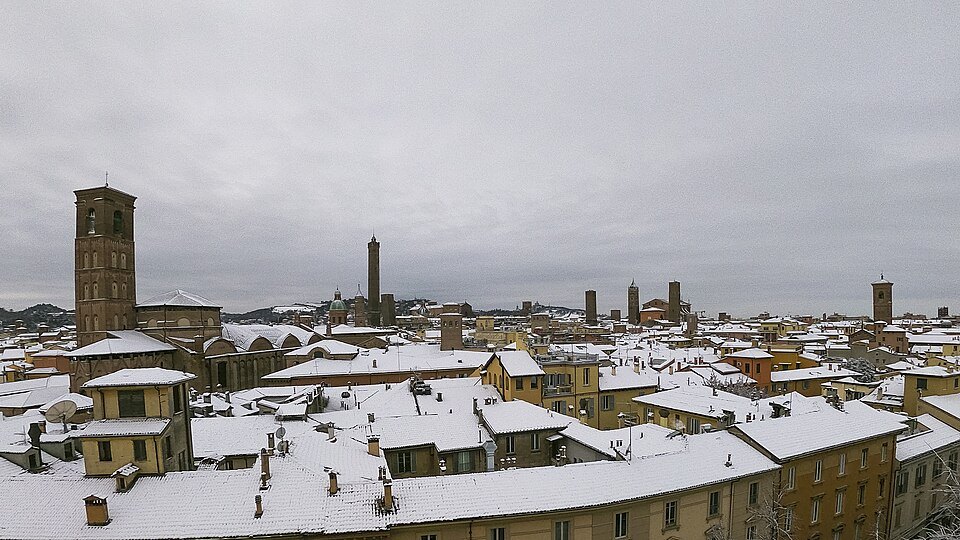 Where to see Bologna from above when you cannot climb the tower
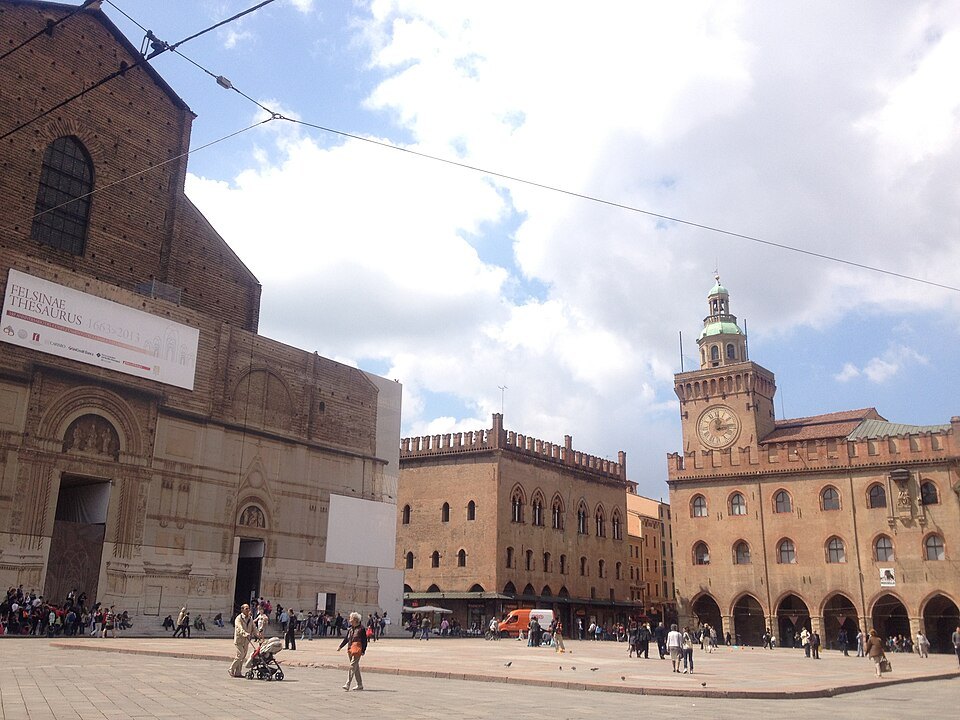 Spend your first evening in Bologna under the arcades