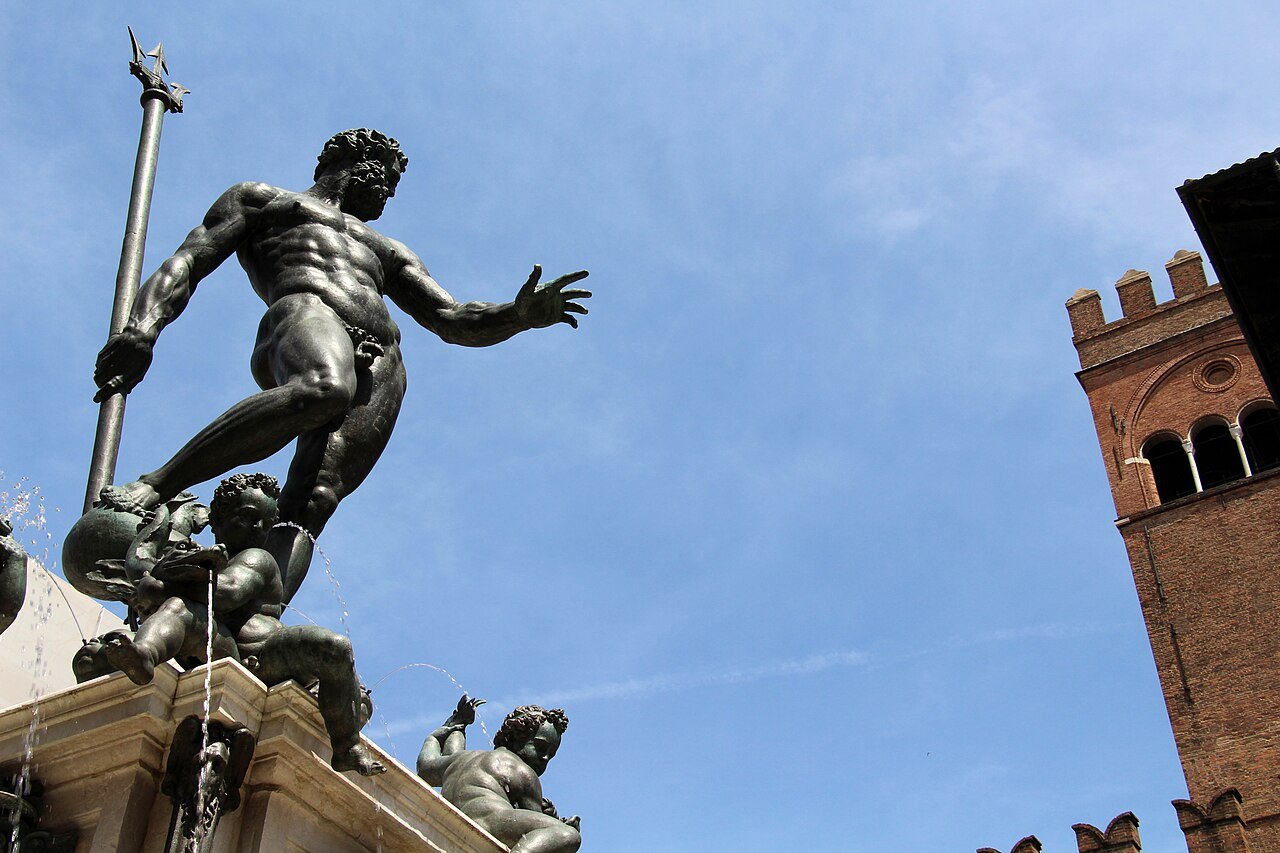
Most visitors arrive at the fountain, glance up at the bronze giant with his trident, take a photograph, and move on toward Piazza Maggiore. That is a shame, because Neptune is only the headline act. The fountain beneath and around him is crowded with smaller figures, each one doing something deliberate, and together they turn a civic water feature into one of the more confident pieces of sixteenth-century sculpture anywhere in Italy.
Start at the base, not the top
Before looking up, walk a slow circle around the octagonal basin. Four sirens recline at the corners, each one twisting her body and squeezing her own breast, from which a thin jet of water once arced outward. The pose looks strange until you realize it is a joke on classical mermaid imagery turned into plumbing: the sculptor has made the water itself part of the figure's anatomy rather than something sprayed from a shell or urn. Look closely at the faces — they are not identical, and the modeling of the hair and shoulders shows a sculptor working at the top of his abilities on what was, for its time, a technically audacious bronze casting job.
Below the sirens, four cherub-like putti wrestle with dolphins, gripping them around the neck in poses that suggest real physical effort rather than decorative cuteness. These were cast separately and assembled on site, and the seams are part of the fountain's engineering story: getting large bronze figures this size cast and fitted together without visible joins was itself a feat worth noticing, even if you have no background in metalwork.
The platform and its animal heads
The octagonal base that holds the whole upper structure is ringed with lion-mask spouts, which is where most of the fountain's actual water flow has historically emerged — the dramatic upward jets around Neptune are secondary to the quieter, constant discharge from these masks lower down. Spend a moment at eye level with one of them. The carving goes well beyond a generic lion face: the proportions, the fall of the mane, and the slight asymmetry between left and right make clear that this was not treated as filler decoration.
Come back at a different time of day if you can, ideally once in full sun and once in softer light. The bronze reads completely differently depending on the angle of light hitting the lion masks and sirens — in harsh midday sun the detail flattens out, while early or late light brings out the modeling that is easy to miss on a quick pass. For general guidance on when the piazza is at its calmest, see when to come.
Reading the whole composition
The fountain was never meant to be read as a portrait of Neptune alone. It is a pyramid of authority: the god at the top, the sirens and putti arranged beneath him in a hierarchy of scale, and water flowing down through all of it as a continuous, visible system. Commissioned in the sixteenth century as a statement piece for a city asserting its own importance, the whole assembly was meant to be seen as a unit — civic confidence expressed in bronze and stone, sited deliberately at the edge of the square in front of what is now the seat of city government.
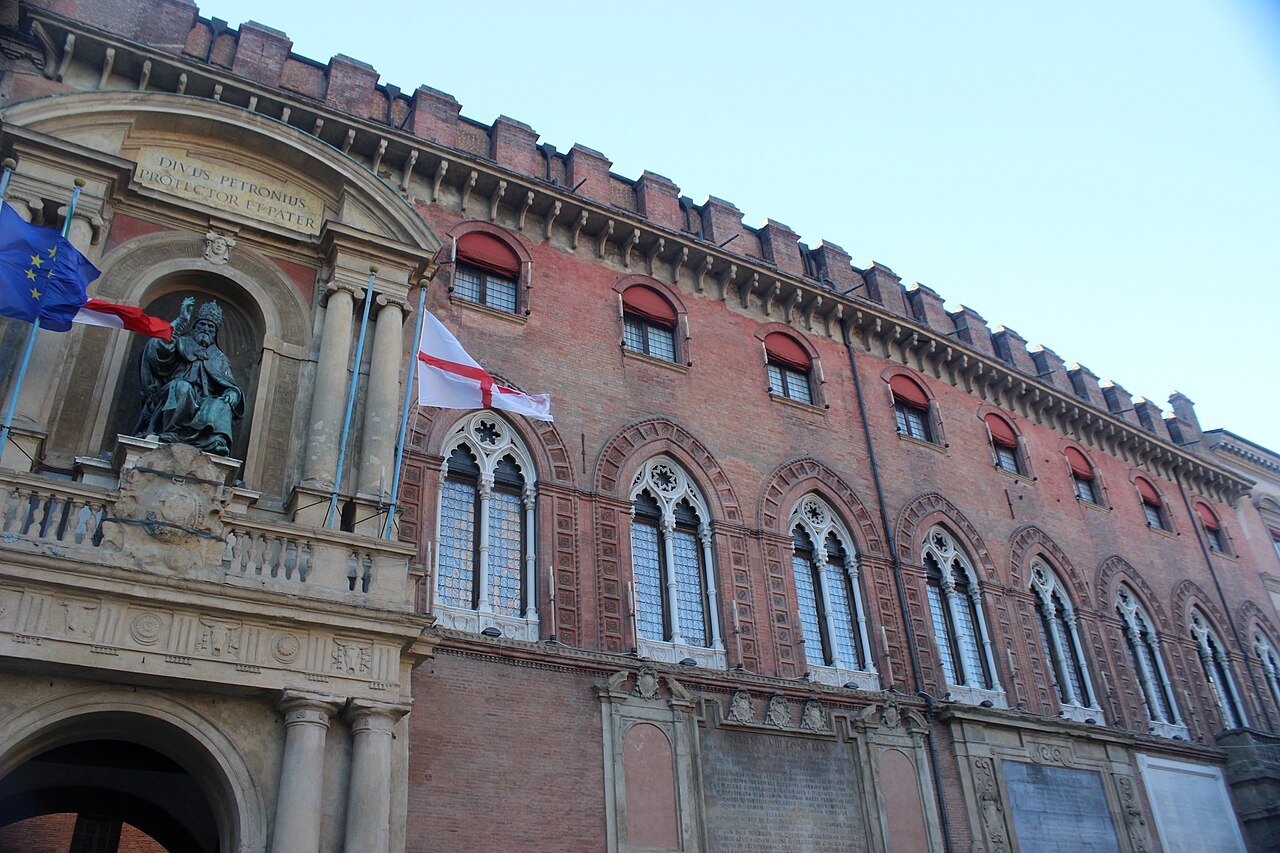
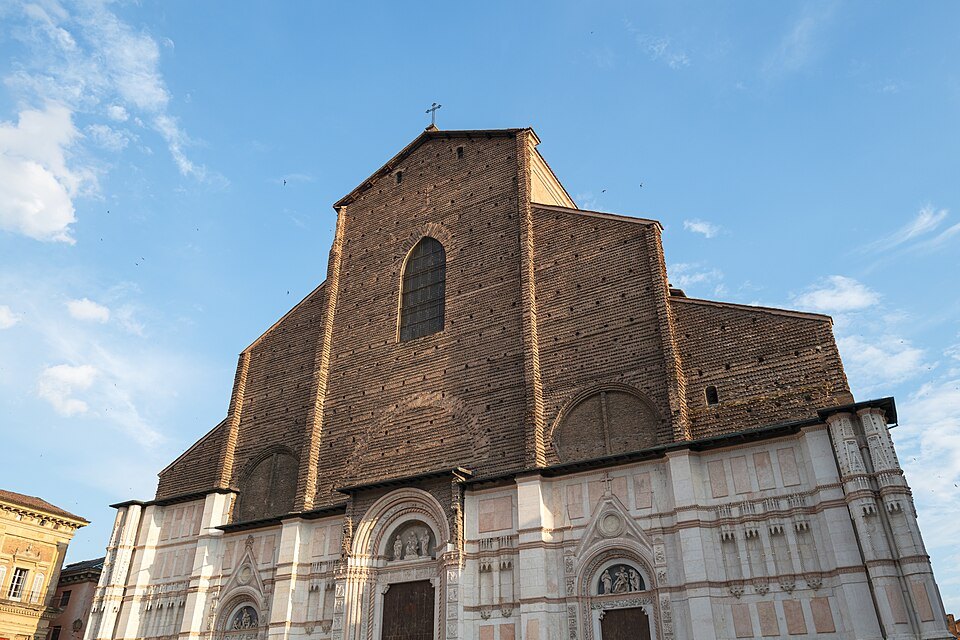
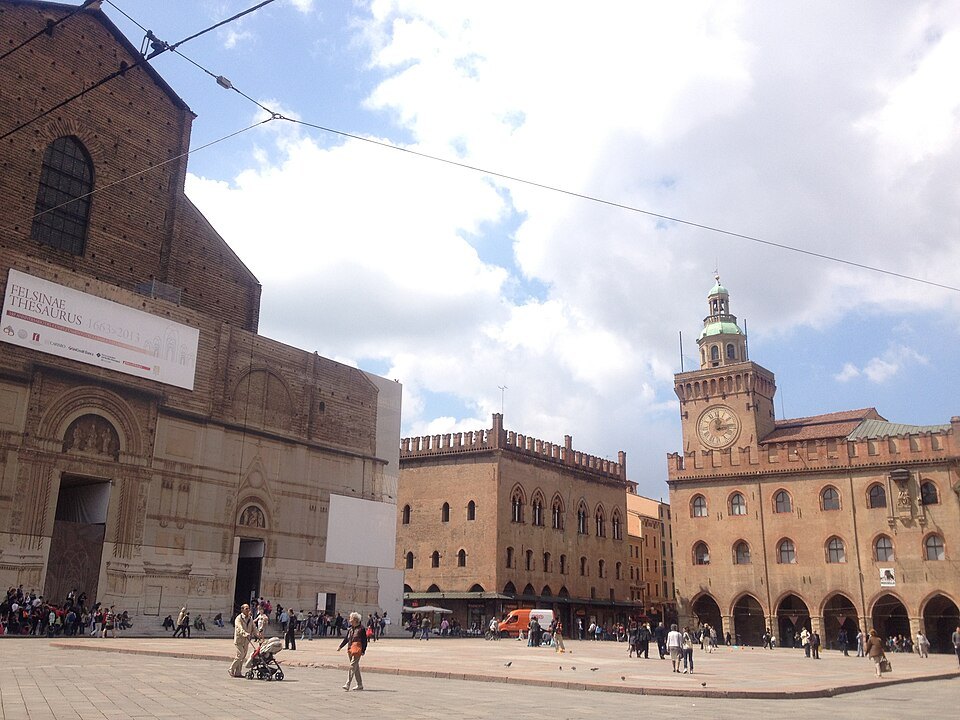
That siting matters. The fountain sits just outside Palazzo d'Accursio, within sight of the steps where official business of the city has long been conducted, and a short walk from the main façade of San Petronio. Standing between the fountain and the basilica, you get a sense of how tightly packed Bologna's symbols of civic and religious power are in this one stretch of pavement — something explored further in the piece on why San Petronio's façade is half marble and half brick, which covers the unfinished ambitions written into the stone a few steps away.
Details that reward patience
- The scallop shells worked into parts of the upper structure are easy to miss against the mass of the sirens and putti below, but they tie the fountain's imagery back to conventional water symbolism of the period, grounding the more inventive siren design in something more traditional.
- The tridents and gestures of the smaller figures all point inward and downward, toward the water, rather than outward toward the piazza — a compositional choice that keeps your eye moving around the fountain rather than away from it.
- The patina on the bronze varies noticeably between the figures closer to street level, which get touched, rained on, and weathered more directly, and the upper sections, which have a smoother, darker surface. It is a visible record of centuries of exposure rather than a flaw.
Note The basin's edge and the stone steps around it get slippery when wet, and the area draws dense foot traffic at most hours. Keep an eye on where you are stepping rather than only looking up, especially if you are circling the fountain with a camera or phone out.
Fitting it into a wider visit
The fountain works well as a hinge point rather than a destination in itself. From here it is a short walk into the covered walkways that define much of the city center — if you have not yet read about why the porticoes look the way they do, the piece on why Bologna built arcades and why the law kept them open is worth it before you wander further. Piazza Maggiore itself is also worth lingering in beyond the fountain, particularly in the evening; see the note on summer evenings when the piazza becomes an open-air cinema if your visit coincides with the warmer months.
For a first orientation to the surrounding streets and what else sits within easy reach — the basilica, the towers, the market district — the general sights overview is a useful starting point, and the full fountain page at Fontana del Nettuno covers the history and the figure of Neptune himself in more depth. If you are mapping out how this stop connects to the rest of a walking day, the itineraries page groups it sensibly with nearby stops so you are not backtracking across the center more than necessary.
 What the whispering corner under the Podestà actually does
 Summer evenings when Piazza Maggiore becomes an open-air cinema
 Spend your first evening in Bologna under the arcades